

Sustained accessibility
Reduced Fees
Promoting Access to Care
Traditionally, determining a reduced fee for clients has been established using a sliding scale. Clients are asked to provide information including their annual salary and household size. Providers then "slide" their fee along a "scale" to make services more affordable.
As society shifts and economic hardships become more nuanced, it has become unrealistic to look solely at gross pay and household size to determine financial need. The "green bottle method," developed by Alexis Cunningfolk, is an approach rooted in social justice that seeks to provide increased access to services by considering the client's overall financial experiences. Beyond looking at just a clients income, this approach empowers client's to consider their ability to engage in upward mobility, prepare for unexpected expenses, and fully engage in the small pleasures of life.

Determining Need
By setting 3 tiers for fees using the green bottle method, I am attempting to promote sustainability for both the client and clinician.
Tier three reflects the true cost or "market rate" of service.
Tier two seeks to increase sustainable access to services. For example, a client identifying with tier two financial experiences may be able to afford the full rate for a short period of time, but may need to end services prematurely due to financial stress.
Tier one is set at the minimum fee necessary to build a sustainable practice. This fee covers costs associated with providing services (e.g., office rent, liability insurance, record keeping software) while maintaining a reasonable caseload.
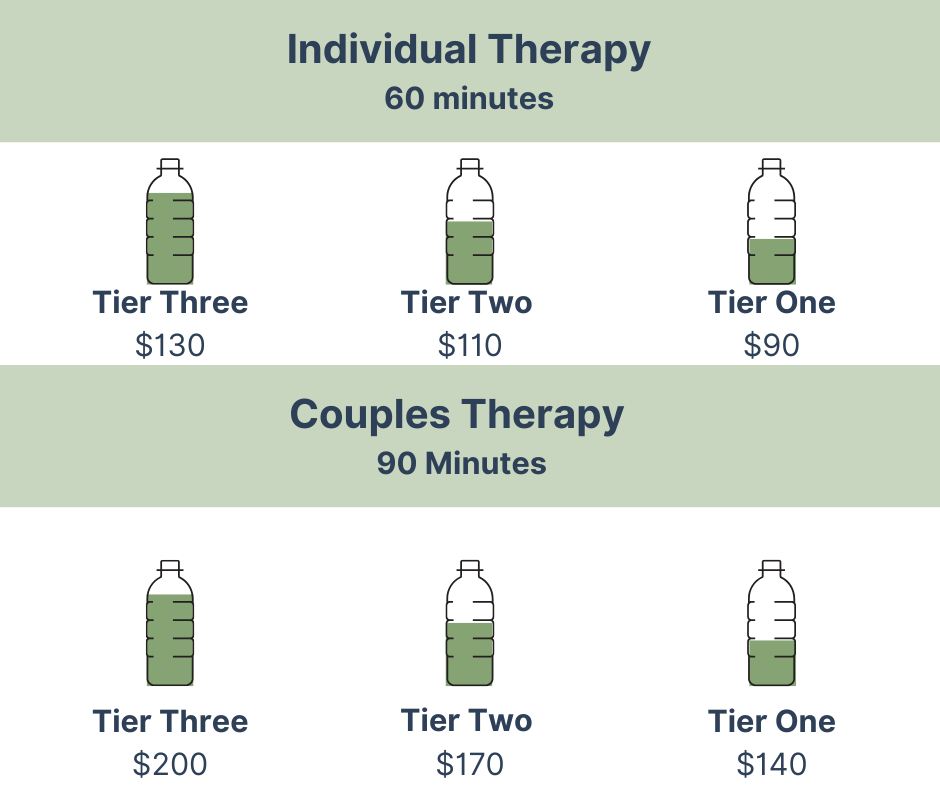
If a reduced fee would remove barriers to sustainable mental health treatment, please request a reduced fee application at anytime. No proof of income is required. Fees are reviewed annually and may be subject to change with a minimum notice of 1 month.

Working with a graduate student intern is a cost-effective option for mental health care. Student interns are completing their master’s program in mental health counseling or a related field and are under the supervision of a fully-licensed therapist. Learn more about working with Inspired Changes Relational Counseling’s current graduate student intern here.
Stay connected
Sign up for practice updates, free resources, and upcoming events. Privacy is of the upmost importance to us - your data will not be sold.